Table Of Content

UDL is about being proactive, not reactive; it's about designing with the foresight of these needs in mind. Design and deliver all course elements for maximum accessibility to give every student equitable opportunities for success. The reflection and redesign phase allows you to consider your next instructional moves. To understand what Universal Design for Learning (UDL) is, it helps to understand what it’s not. This website is using a security service to protect itself from online attacks. There are several actions that could trigger this block including submitting a certain word or phrase, a SQL command or malformed data.
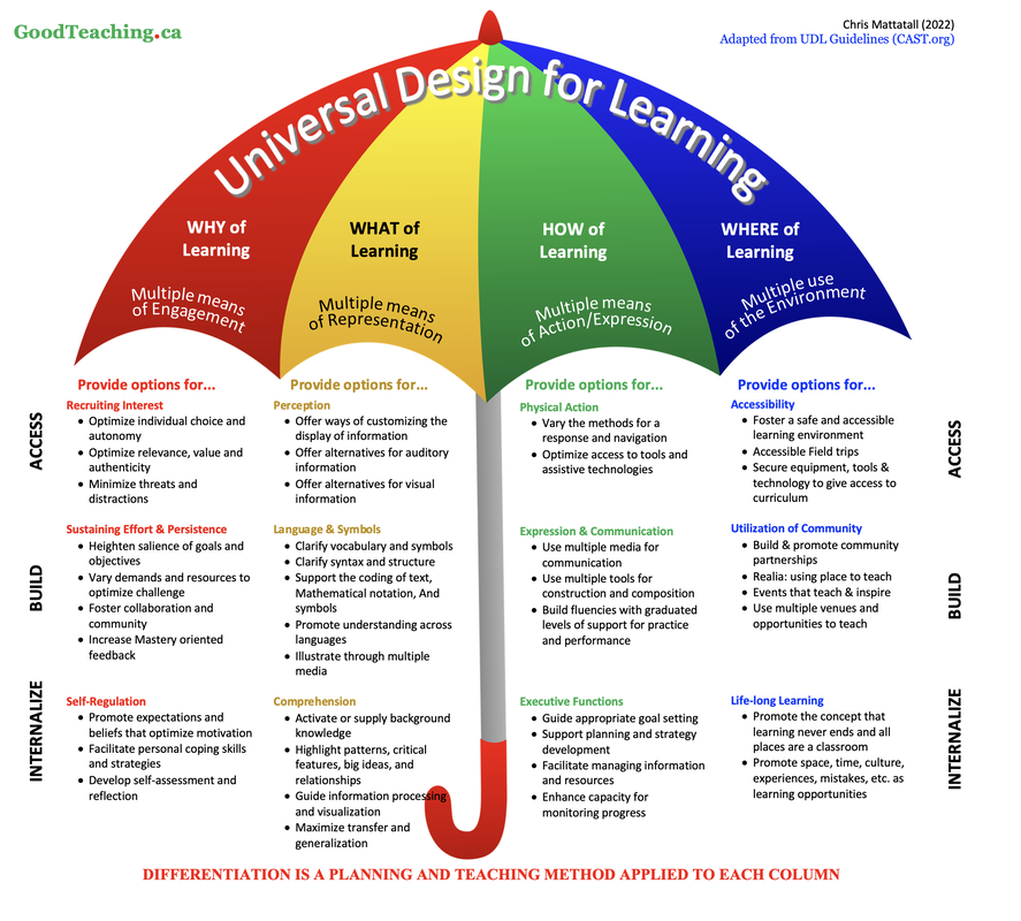
Teach all students in your classroom, including those that can be the hardest to reach.
These guidelines offer a set of concrete suggestions that can be applied to any discipline or domain to ensure that all learners can access and participate in meaningful, challenging learning opportunities. In the same way, Universal Design for Learning can help all learners reach their full potential. Learners receive and process information in different ways, work at different rates, have varied family and cultural backgrounds and bring different knowledge and experience to their learning. It is important to plan, program, teach and assess using evidence-based practices that cater for the full range of students.
Action and expression
UDL is regarded so highly that it’s mentioned by name in the nation’s main education law. The Every Student Succeeds Act (ESSA) encourages states and districts to use federal funding to help teachers expand the use of UDL. This site is a joint resource provided by the Teaching Engagement Program and UO Online. Situated within the Office of the Provost, our units work collaboratively to support the teaching mission of the University of Oregon.
UDL to Change the World
This could involve providing text-to-speech options, video with subtitles, or illustrated diagrams -- all of which are invaluable for learners with varying levels of language proficiency. Universal Design for Learning (UDL) brings with it a host of benefits that transform the educational landscape. Primarily, it facilitates instructional goals and methods that are inherently adaptable. This flexibility means that materials and assessments can be tailored to individual requirements. In the ever-evolving classroom, variability among students is a given, and UDL helps teachers anticipate and plan for these differences from the onset. Universal design for learning (UDL) is a teaching approach that works to accommodate the needs and abilities of all learners and eliminates unnecessary hurdles in the learning process.
Tackling Universal Design Learning to Make Teaching Easier - Newsela
Tackling Universal Design Learning to Make Teaching Easier.
Posted: Thu, 18 May 2023 07:00:00 GMT [source]
Tuition Assistance
Curriculum planning for every student in every classroom (AC00180) professional learning is available in MyPL. (NSW Department of Education Strategic Plan, 2021) as well as the national education goal of promoting excellence and equity (The Alice Springs (Mparntwe) Education Declaration, 2019). Participants should plan to devote an average of three to five hours of work per week. Each week, participants will engage in 1 60-minute webinar, 1-60 minute small group meeting, and 2-4 hours of individual work to apply course materials to their own contexts. Participants who complete all individual activities and contribute to group discussions prior to the end of the program period will receive a certificate indicating the completion of fifteen clock hours of instruction. To cater to the varied ways students comprehend information, UDL advocates for the delivery of content through multiple means of representation.
UDL helps build in more ways a diverse group of learners can access information and show what they know. Universal Design for Learning (UDL) is an approach to teaching and learning that gives all students equal opportunity to succeed. Our faculty have relevant industry experience in learning and instructional design and are committed to fostering your professional growth. Provide multiple means of representation to give learners options to acquire information and knowledge from curriculum content.

Multiple Means of Engagement
This flexibility is not only about providing alternatives but about embedding inclusivity into the fabric of educational materials and methods. Universal Design for Learning, often abbreviated as UDL, is an educational framework that seeks to enhance learning experiences for all students. It is grounded in scientific insights into how humans learn and adapts to their diverse needs. Rather than focusing solely on the acquisition of technical skills, the program emphasizes a holistic understanding of instructional design. As the capstone project, you will design a learning experience for a real-world application that demonstrates the application of theories and concepts.
This approach to teaching doesn’t specifically target kids with learning and attention issues. But it can be especially helpful for the 1 in 5 kids with these issues — including those who have not been formally diagnosed. Make sure that children in your classroom feel comfortable and safe bringing their whole selves—including their race, heritage, gender identity, and disabilities—into your classroom and address bias. One simple but effective way to do so is by stocking your classroom library with books that reflect your students’ diverse backgrounds and experiences. The UDL Guidelines are a tool used in the implementation of Universal Design for Learning. The goal of UDL is to use a variety of teaching methods to remove any barriers to learning.
Phuong and Berkeley, using a randomized controlled trial, found that AEP, which is based on UDL, led to a significant improvement in students’ grades, even when several confounding variables were controlled for. Assure families that you have high expectations for all students to become expert learners in your classroom. And explain that you’ll keep working with the students and their families to build the skills and interest to make that happen. This approach to teaching or to workplace training doesn’t specifically target people who learn and think differently. But it can be especially helpful for kids with these challenges — including those who have not been formally diagnosed.
Imagine entering a classroom where every student has an equal opportunity to learn, regardless of their abilities or disabilities. This is the goal of Universal Design for Learning (UDL), a revolutionary approach to education. Originating in architecture as a way to create buildings accessible to all people, UDL applies this inclusive mindset to the learning environment.
According to this educational framework, doing so is the best way to recognize a student’s strengths and challenges, and to limit any learning barriers at your school. UDLA reflects UDL in content and inclusive design to build our understanding and extend our application of how to intentionally design practices to engage all students to be expert learners in quality inclusive environments. The core of UDL lies in its three main principles, structured around engagement, representation, and action & expression.
These principles were developed in the 1980’s and are also known as a human-centred approach to design. Examples in everyday life include automatic doors, closed captions and ramps. For example, ramps are used by people in a wheelchair to access buildings and are also used by parents with prams and elderly people with walkers.
CAST created the Universal Design for Learning framework, and it remains one of our core levers of change to help make learning inclusive and transformative for everyone. Leif E, Alfrey L and Grove C (2021).Practical, research-informed strategies to teach more inclusively (teachermagazine.com), accessed 26 April 2023. A multi-tiered system of support for individuals, schools, and districtsseeking to implement Universal Design for Learning.
Developed by the CAST organization, Universal Design for Learning (UDL) is a framework to improve and optimize teaching and learning for all people based on scientific insights into how humans learn. Inclusive instructional design provides greater opportunity for learners to engage in learning and fully demonstrate their knowledge, understanding and skills. Using the Universal Design for Learning principles to proactively plan teaching and learning programs will reduce the need to retrospectively plan individual accommodations and personalised adjustments. To support students with language skills, UDL champions the creation of learning environments that consider everyone. It extends beyond merely addressing disabilities, visible or otherwise, and speaks to the very essence of individual learning needs. For instance, when presenting information, UDL underpins the importance of consistency and clarity, while simultaneously offering information in multiple formats.
Lesson planning with Universal Design for Learning (UDL) can help you design your lessons to teach the range of students in your classrooms. Sometimes students didn’t have background knowledge, so we’d cover relevant topics and skills at the start. Other times, content wasn’t academically interesting or culturally relevant, so we found ways to tie it to their lives. I realized that many students needed clearer directions, checklists, and check-ins, so I created systems within our classroom to address this. I won’t pretend it’s easy, but it’s crucial to commit to the UDL mindset in order to have success.


No comments:
Post a Comment